

Activity 4

Matter Waves

Goal

We will use the results of the previous experiments and establish quantitative concepts for electron waves.

Prerequisites

Explain the evidence that matter can behave like waves.

Introduction

In the previous activity, we saw that in certain experiments electrons produce patterns attributed to waves. From this observation, we concluded that electrons have wave-like properties. You also concluded that as the energy of electrons increases their wavelength decreases. Electrons are a form of matter, so these waves are called matter waves. In this activity, we will relate quantitative features of matter waves with familiar, measurable physical quantities such as energy, mass, and momentum. We will apply these relationships to forms of matter other than electrons, and see how these results can be applied to the electron microscope.
Louis de Broglie was the first person to establish an equation for the relationship between an electron’s momentum and its wavelength. He concluded that:


where h is a number called Planck’s constant (named after Max Planck) and is equal to 6.63 x 10⁻³⁴ J × s or 4.14 x 10⁻¹⁵ eV × s. When we observe electron diffraction, the electrons’ kinetic energy is easier to measure than their momentum, so we write the de Broglie wavelength as


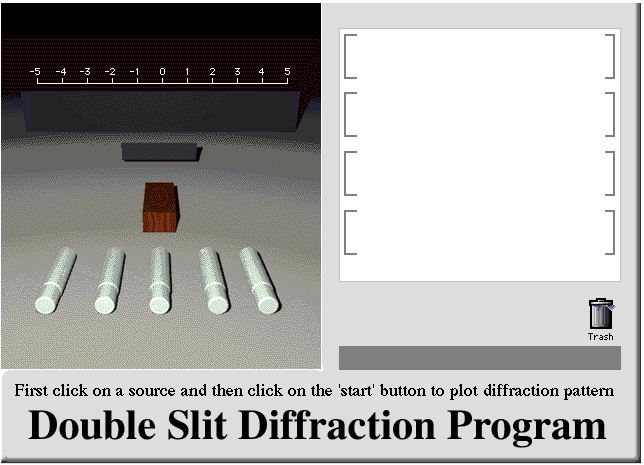
This equation is consistent with our results in the previous activity — as the energy increases the wavelength decreases. While we have learned about this equation using electrons, it can be used for any type of matter. So, you might wonder why we do not see wave effects for large objects. Start the Double Slit program with this link. As in the previous activity, the program screen should look like the figure below.
Double slit screen

To begin to understand and experiment with objects with masses greater than that of an electron, run the simulation of the experiment for electrons.Throughout this experiment keep the same energy. Next choose pions and repeat the process. Repeat for neutrons, and finally protons. (A pion has a mass 270 times that of the electron while the neutron and proton masses are about 2,000 times that of the electron.) After doing these experiments, feel free to vary any of the parameters except the energy. Then, answer the following questions. Compare the diffraction patterns made using the other types of matter with that of the electron.


? How do the distances between dark areas change with the mass?


? How does the de Broglie wavelength change?


? How do the patterns for protons compare to the patterns for neutrons?


? Use de Broglie’s hypothesis to explain this similarity or difference.


Now, investigate how the patterns change as the separation between slits changes. Pick one particle and one energy; change the slit separation to answer the following.

? How does the pattern change as the slit separation increases?


1 2 3  | Next page