Rami Arieli: "The Laser Adventure" Chapter 7 Section 5, page 4
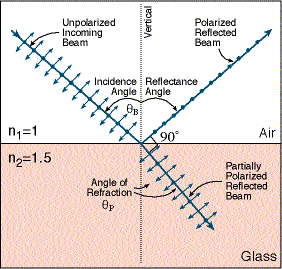
Brewster AngleIn 1812 Brewster found that maximum polarization is achieved when the transmitted beam and the reflected beam make an angle of 900 as seen in figure 7.26.
In general, for every material there is a special angle, called polarization angle, where only light polarized perpendicular to the beam plane has a reflected component.
Thus, at the polarization angle the reflected beam is 100% linearly polarized.
The transmitted component into the other medium include all the components polarized parallel to the beam plane, and some of the beam polarized perpendicular to the beam plane. Thus, the transmitted beam is partly polarized.
When the incident beam is at the polarization angle, the reflected beam is perpendicular to the transmitted beam. Thus, the refraction angle qP is the complement angle to the polarization angle qB:
Using Snell low:
Using the mathematical relation found by Brewster, the result is:
Thus, Brewster low for calculating the polarization angle, is called on his name Brewster Angle: