Rami Arieli: "The
Laser Adventure" Chapter 9.4.2 page 8
The Xerography process
The Xerography process creates a printed page in 5 stages, as described
in figure 9.11.
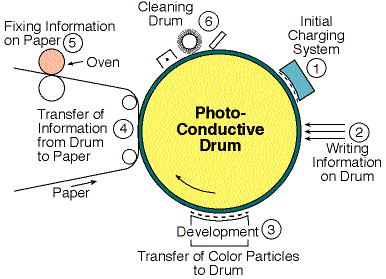 Figure 9.11: Basic system for Xerography
The system is based on a spinning drum,
which is build from a metallic conductive substance,
which is covered by a thin dielectric insulator,
that is sensitive to light (photo-conductor).Examples
of photo-conductive materials are: Amorphous Selenium and Cadmium Sulfide.
Figure 9.11: Basic system for Xerography
The system is based on a spinning drum,
which is build from a metallic conductive substance,
which is covered by a thin dielectric insulator,
that is sensitive to light (photo-conductor).Examples
of photo-conductive materials are: Amorphous Selenium and Cadmium Sulfide.
-
The width of the thin dielectric layer is of the order of 20-100 micron.
-
The electrical resistivity of these materials in the dark is of the order
of: 1014-1016 [ohm-cm].
Thus, electric charge on this dielectric layer will remain as long as this
material will not be exposed to light.
The photo-conductive material becomes conductive
when expose by light. That means that if we first charge the
entire photo-conductive drum with positive electric charge, and expose
only certain parts of it to light, the electric charge will disappear only
in those lighted regions.