Rami Arieli: "The Laser Adventure" I-V Curve Page 3
Experimental
Procedure:
-
Build the DC electrical circuit as shown in the Figure 1, by connecting
various components (batteries, laser diode, multimeter etc.) using wires
with alligator clips. Make sure the polarities of the battery and the laser
diode (or LED) is correct.
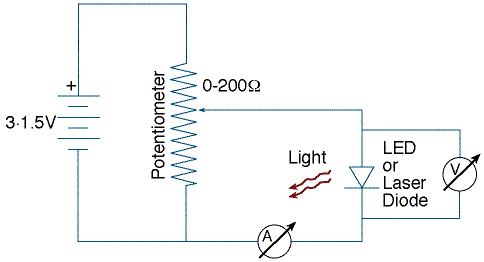 Figure1: Experimental Set-up.
-
Separately connect the third multimeter (not shown in the diagram above)
to the two leads of the “power meter” and turn it “ON”. Set the power meter
as close to the laser diode (or LED), so that the light from the
laser diode (or LED) goes directly through the hole in the power meter.
In fact, you can insert the laser diode (or LED) directly into the opening
of the power meter. Do not move any part of the set-up once you have
assembled it. That will affect the reading of the power meter from
the background glare.
-
Turn “ON” the two multimeters that are connected in the circuit. Slowly
change the voltage applied to the laser diode (or LED), by sliding the
bar of the potentiometer in from one end to the other, As you do so, the
current and voltage readings in the two ammeters will change.
-
Record (on the data sheet) the current (in
[mA]) and voltage (in [Volts]),
in small increments starting at 0V.
-
For each value of voltage and current, record also (on the data sheet)
the output of the power meter (in [mV]).
-
Mark (on the data sheet) the value of V and I at which you can identify
a visible output for the Laser Diode (or LED).
-
From the recorded data, draw a graph of the current vs. voltage (I-V
curve).
-
From the recorded data, draw a graph of the reading of the power
meter vs. voltage.
-
From the graphs find:
For the laser diode:
-
The first point where the slope changes abruptly and the laser barely
begins to glow (“Turn on” voltage).
-
The second point where the slope changes abruptly and the laser
begin to glow very brightly (“Lasing Threshold” voltage).
For the LED find:
-
The first point where the slope changes abruptly and the laser barely
begins to glow (“Turn on” voltage).
There is NO Lasing Threshold voltage for the LED,
since it is NOT a laser.