We will use learn about the electromagnetic spectrum.
We will build a device to decompose visible light into its component
colors
Prerequisites
Conservation of Energy
Introduction
You may have heard that the microwaves in your microwave oven are
closely related to the signal that brings information to your radio or
to radar that police use. (In fact, one of the first microwave
ovens was called the
Amana Radarange.) Light is also very closely related to these
types of energy. We classify all of them as forms of
electromagnetic energy. The term
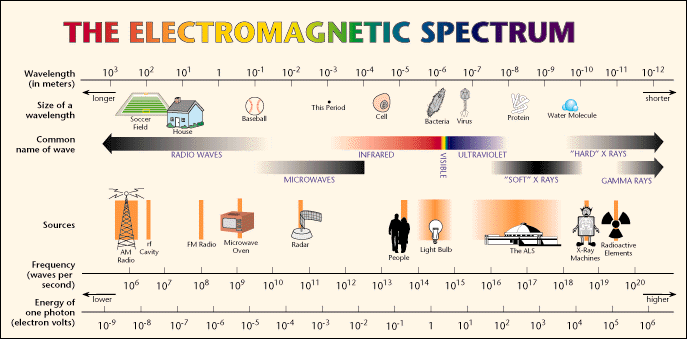
electromagnetic spectrum is the name of the distribution of
electromagnetic energy according to the energy (or equivalency
according to wavelength or frequency). The figure below shows the
spectrum of sun light distributed according to wavelength, frequency and
energy. To give you an idea of the length scale we provide you with
objects of similar size as the wavelength.
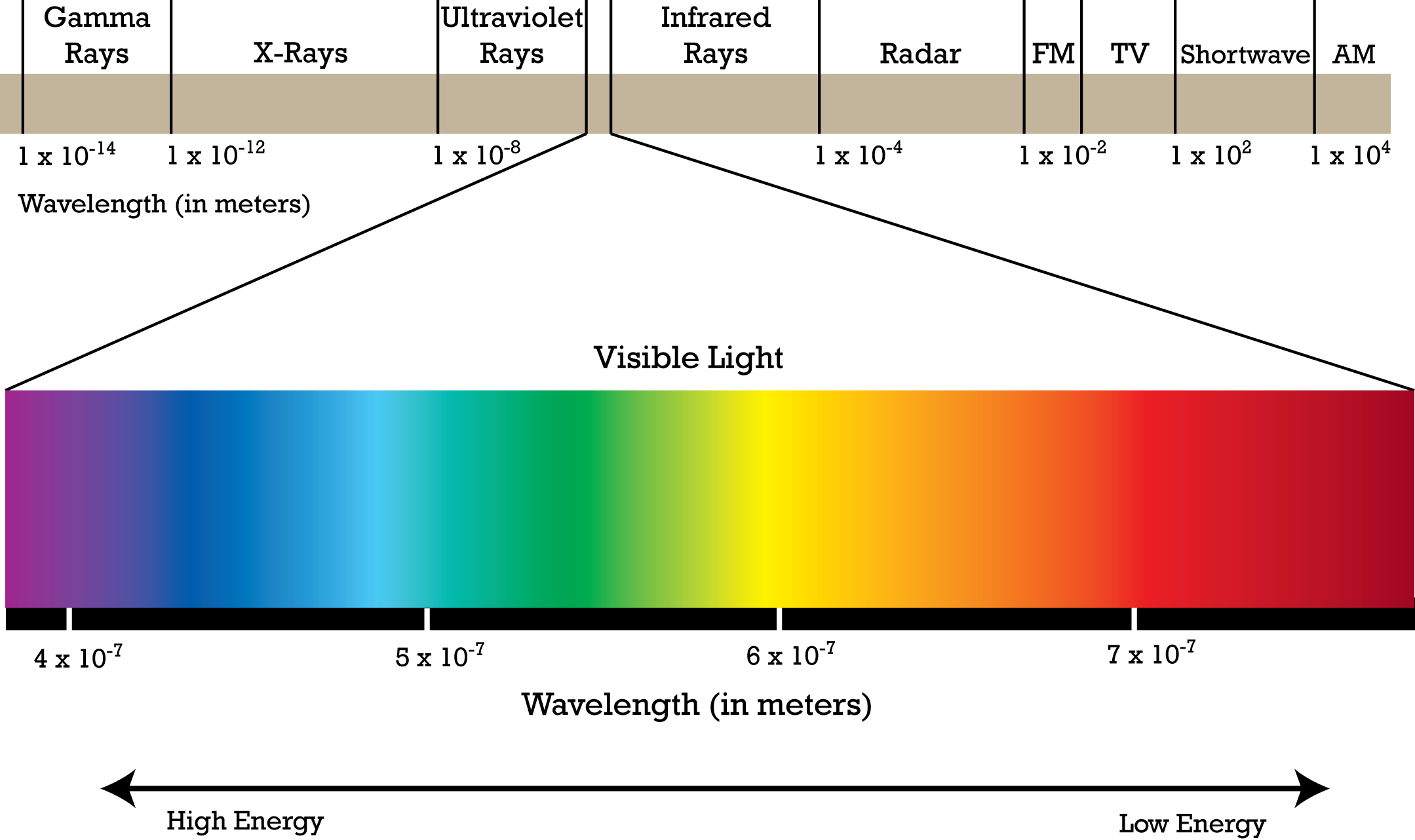
You can see that the visible light is a very small fraction of the
light spectrum. The visible part of the spectrum is shown below
and ranges in wavelength from about 380-780 nm (nm = nanometer = 10-9meter
= 0.000000001 meter) While it is common to express the visble
light spectrum in terms of wavelngth, we will find it most useful to
discuss it in terms of energy.
There are many introductions to the electromagnetic spectrum on the
web. Two introductions produced by NASA are linked below. The
first is a five-minute NASA video which is aimed at middle school
students. The second is a little more advanced and about 30 minutes
long.